

An appraisal answers one question: what is this gold actually worth, and why. At 5 Star Gold Silver & Diamond we go through that calculation with you at our Banks Road office, using your item’s purity, its weight and the gold spot price at the time of your visit. There is no charge for the assessment and no obligation to sell afterward.
Three numbers decide it, and nothing else does most of the work. Purity, meaning how much of the item is gold rather than alloy, set by its karat. Weight, meaning how many grams the item weighs. And the spot price, meaning what a gram of pure gold is trading for on the global market right now.
Multiply purity by weight and you have the amount of actual gold in the piece. Multiply that by the spot price per gram and you have its gross metal value. Everything else is either a deduction from that figure or, for a designer or collectable piece, a reason to set the metal calculation aside and value the item on different terms.
The numbers below are illustrative only. They are not a current rate and not a guaranteed payout. They are here to show the arithmetic.
Say you have a 14k gold chain weighing 20.0 grams.
That last figure is the value of the gold inside the chain at the illustrative rate used. It is the starting point of an offer, not the offer itself. The difference between gross metal value and the amount paid covers refining, assay and handling, which are real costs that apply to every buyer in the market. What we will do is show you each of those three numbers for your specific item, tell you the live spot price we used, and explain how the final figure was reached before you decide anything.
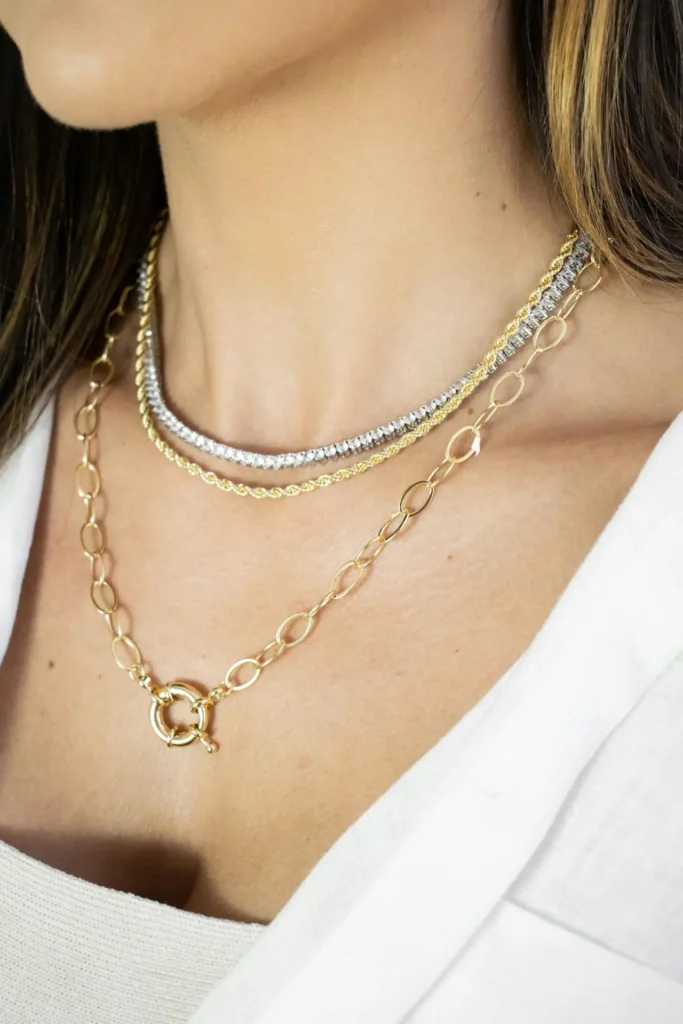
Gold is too soft to wear in pure form, so jewellery gold is alloyed. The karat mark tells you the ratio. Look inside a ring band, on a chain clasp, or on the back of a pendant.
| Stamp | Also marked | Gold content |
|---|---|---|
| 10k | 417 | about 41.7% |
| 14k | 585 | about 58.3% |
| 18k | 750 | 75.0% |
| 22k | 916 | about 91.6% |
| 24k | 999 | 99.9% |
The three-digit European marks are the same information written as parts per thousand, and they round slightly, which is why 14k shows as 585 rather than 583.
The practical consequence is large. A 10k chain and an 18k chain of identical weight do not contain similar amounts of gold; the 18k chain contains roughly 80% more. This is the most common source of surprise at the counter, and it is why purity is confirmed before weight is discussed.
Some marks need care. GF, GP, RGP, HGE and 1/20 12K indicate gold filled, gold plated or rolled gold, which carry a thin layer of gold over a base metal and are worth a small fraction of solid gold of the same weight. An unstamped item is not necessarily plated; older and handmade pieces are often unmarked, and testing settles it either way. Our article on how gold is verified explains how that testing works.
Precious metals are not weighed in the ounces used for groceries. A troy ounce is 31.1035 grams, while a standard ounce is 28.35 grams. Anyone converting between the two casually will be out by about 10%, always in the same direction.
Jewellery is weighed in grams. Bullion is usually described in troy ounces but weighed the same way. Gemstones are weighed in carats, a different unit again at 0.2 grams each, and a stone’s weight is never included in the metal calculation. Items are weighed individually wherever karats differ, because a single mixed weight cannot be converted back into a purity-accurate figure. If you bring in a bag of assorted chains, expect them to be sorted by karat first.
Our Kelowna office is equipped to handle a wide range of precious metal appraisals, including:
Fine Jewelry: Detailed grading for modern and vintage pieces, including those featuring sell diamonds Kelowna.
Gold Coinage: Expert numismatic and bullion assessments for sell coins Kelowna.
Industrial & Scrap Gold: Accurate weight and purity checks for scrap gold and silver.
Estate Collections: Comprehensive itemization for sell estate jewelry Kelowna.
Platinum items are covered on sell platinum Kelowna.
Spot price is the price of one troy ounce of pure gold on the global market. It is set by international trading, not by any local business, and it moves continuously through the trading day. We check the live rate at the time of your visit and calculate from that figure, which is why a quote from three weeks ago is not a useful comparison to one from today.
From gross metal value, an offer accounts for refining and assay, since scrap gold has to be refined back to purity before it re-enters the market and that has a cost per gram regardless of who handles it; item type, since a single-karat bullion bar needs almost no processing while a mixed lot of broken jewellery with stones, solder and clasps needs sorting and separating first; and resale form, since a recognised mint coin can be resold as it stands but a snapped 10k chain cannot.
Collectable, signed and designer pieces are the exception. Those are assessed for what they are worth as objects before a scrap calculation is ever applied, because for some pieces the metal figure is the lower of the two numbers. The same is true of items covered on our sell estate jewellery Kelowna page.
If you take the same ring to three places you will get three numbers, and the spread is usually explained by four things rather than by anyone being dishonest. When the quote was given, because spot price moves during the day. What is being quoted on, because one buyer may be quoting metal only while another has recognised a signed piece or a saleable stone. How the item is handled afterward, because a buyer who refines everything has a different cost base from one who can resell a piece intact. And whether the same purity was found, because a quote based on a worn stamp and a quote based on a test can legitimately differ.
The way to compare offers is to ask each buyer for the three inputs: the purity they found, the weight they measured, and the spot price they used. If a buyer will not tell you those, the number on its own is not comparable to anything.
These are two different documents answering two different questions, and confusing them is the most common reason a seller feels shortchanged.
An insurance or replacement appraisal estimates what it would cost to buy an equivalent item at retail today. It exists so an insurer knows what to pay out if the item is lost or stolen, and because it is a retail replacement figure it includes manufacturing, setting, retail markup and taxes. It is normally the highest number anyone will ever attach to your item. A purchase offer is what a buyer will pay you for the item as it exists, today, built from its metal and stone content plus any resale value it has as an object. A fair market value appraisal is a third thing again, used for estates and probate, and it sits between the other two.
None of these is the correct value. They answer different questions. An item with a high insurance appraisal and a much lower purchase offer is behaving completely normally, and the gap is not evidence of a lowball. If you are holding an appraisal document, bring it. It tells us what a professional found in the piece, which is useful information even though it is not the figure a sale is based on. For rings, stones and other finished pieces, see our jewellery appraisal page.
Items are separated by metal and by karat, because mixed lots cannot be valued as a single weight. Hallmarks, karat stamps and maker’s marks are recorded where present, and purity is then confirmed using professional testing appropriate to the item rather than taken from the stamp alone. Each item, or each karat group, is weighed in grams in front of you. The live gold spot price is checked at the time of your visit. You are told the purity, the weight and the spot price used, and how they combine into the number offered.
The assessment is free and the offer carries no obligation. If you accept, payment is immediate. If you would rather keep the item and access its value another way, we also offer loans against gold or silver. If you decide to proceed with a sale, sell gold Kelowna covers how that works.
These answers cover what determines a gold valuation and what to expect at the counter.
It depends on three things: the karat, the weight in grams, and the gold spot price at this moment. Multiply the weight by the karat percentage to get the grams of pure gold, then multiply that by the spot price per gram. A 20 gram 14k chain contains about 11.66 grams of pure gold, so its metal value moves with the market from there. We will run the exact calculation on your item and show you every figure used.
No. Assessments for customers considering a sale are free and carry no obligation.
For customers looking to sell, we give a verbal market valuation and explain the figures behind it. For a formal written insurance appraisal, which is a different document with a different purpose, please contact us for details.
Because they answer different questions. An insurance appraisal estimates what it would cost to replace the item at retail, including manufacturing and retail margin. A purchase offer is what the item is worth to sell today based on its actual metal and stone content. A significant gap between the two is normal and expected across the industry.
No. Polishing removes a small amount of metal and can wear down the hallmarks that confirm purity, so it works against you on both counts. Tarnish and surface dirt do not affect what the item is worth. Bring it as it is.
Yes. Testing determines the actual gold content of plated, filled and mixed items. Be aware that gold filled and gold plated pieces, marked GF, GP, RGP or HGE, carry only a thin surface layer and are worth a small fraction of solid gold at the same weight. We will tell you what you have either way.
5 Star Gold Silver & Diamond
Welcome to Okanagan Gold, Silver & Diamond Dealers, your premier destination for buying and selling gold, silver, and diamonds in the Okanagan. We are dedicated to delivering exceptional value, transparency, and service to our customers.
5 Star Gold Silver & Diamond
Welcome to Okanagan Gold, Silver & Diamond Dealers, your premier destination for buying and selling gold, silver, and diamonds in the Okanagan. We are dedicated to delivering exceptional value, transparency, and service to our customers.
Copyright © 2026 – 5 Star Gold Silver & Diamond | Web Development Vancouver by BragDeal Inc.